
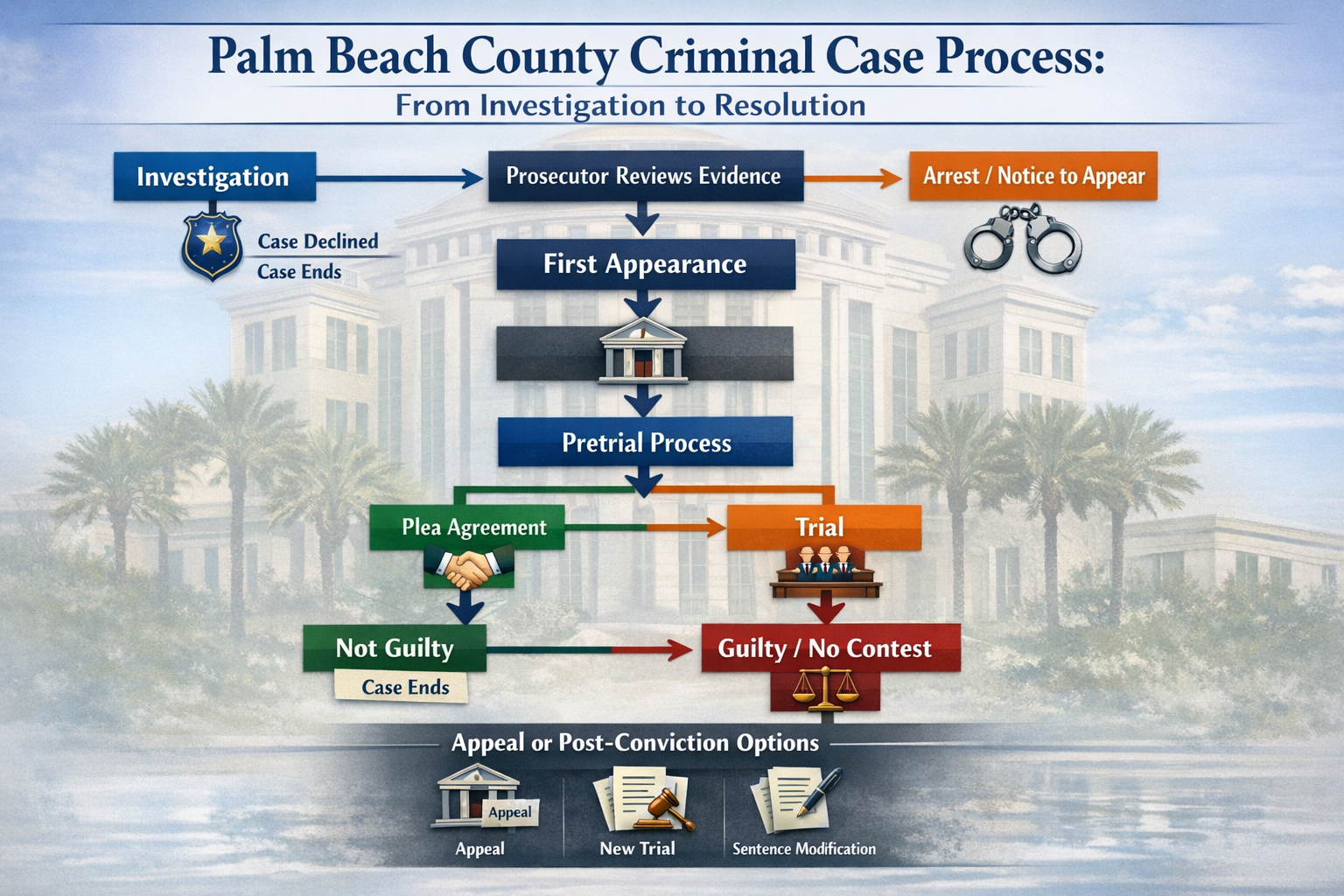
Getting charged with a crime— or even just finding out you’re under investigation— is one of the most disorienting things that can happen to a person. For the typical resident, the legal system in Palm Beach County is complex and even a bit of an unknown.
And that’s a major problem when your rights, your freedom, and your future are on the line.
This guide breaks down every stage of the Palm Beach County criminal case process. For every step, you’ll learn what’s happening, what the timeline looks like, and why having an aggressive defense attorney in your corner can change the outcome.
Criminal Investigations in Palm Beach County (Before the Arrest)
Not every case starts with handcuffs. Sometimes law enforcement builds a case before you’re ever arrested by interviewing witnesses, gathering evidence, and possibly contacting you directly.
If you’re aware that you’re part of a criminal investigation in Palm Beach County, this is the most important moment to act.
You are not required to speak with investigators without an attorney present, and many people unknowingly make self-incriminating statements trying to explain themselves. An attorney engaged during this phase can sometimes influence whether the State Attorney’s Office files charges at all.
Step 1: Arrest or Notice to Appear
A Palm Beach County criminal case officially begins in one of two ways. The first is an arrest, where law enforcement takes you into custody based on probable cause, with or without a warrant.
The second is a Notice to Appear, which is typically issued for misdemeanor charges when the officer believes you’ll show up to court voluntarily. It designates a specific date and location. If you don’t show, a bench warrant is issued for your arrest.
Either way, your rights during an arrest or Notice to Appear in Palm Beach County are the same: you have the right to remain silent and the right to an attorney. Use them both, immediately.
Step 2: Booking at the Palm Beach County Jail
If you were physically arrested, you’ll be taken to the Palm Beach County Jail for booking. This involves recording your personal information, fingerprinting, photographing, and documenting the alleged offense.
At this stage, you’re not officially facing a conviction, a formal charge, or any kind of determination of guilt. Your case is still wide open. Understanding what booking at the Palm Beach County Jail involves can help take some of the fear out of this confusing and sometimes frightening experience.
Step 3: First Appearance (Within 24 Hours of Arrest)
Under Florida Rule of Criminal Procedure 3.130v, anyone arrested in Florida must appear before a judge within 24 hours.
At this hearing, the judge reviews whether probable cause existed for the arrest, informs you of the charges, and sets bond, or releases you on your own recognizance (ROR), which means you aren’t held in custody, nor do you have to pay a bond. If you can’t afford an attorney, the court may appoint a public defender here.
Do not make statements at this hearing. Your primary focus should be on having an attorney present who can fight for you.
An aggressive defense attorney at first appearance can argue for ROR or a significantly lower bond based on your ties to the community, your employment, and the specifics of the charges, which ultimately makes the difference between going home and waiting in a cell while your case plays out.
Criminal case records in Palm Beach County are maintained by the Clerk of the Circuit Court & Comptroller, which also offers a court date lookup tool if you’re trying to track your case online.
Step 4: Filing of Formal Charges
You might be surprised to learn that being arrested is not the same as being charged. After your arrest, the State Attorney’s Office reviews the case and independently decides whether to file charges— and what those charges will be.
They can file exactly what you were arrested for, reduce or upgrade the charges, or decline to file anything at all.
Under Florida Rule of Criminal Procedure 3.134, if you remain in custody, the State has 30 days to file formal charges or must release you. If you’ve bonded out, they have up to 175 days for felonies and 90 days for misdemeanors.
This window is another opportunity for a defense attorney to engage with prosecutors before the case is formally locked in.
Step 5: Arraignment (About 3 to 4 Weeks After Arrest)
Once charges are filed, an arraignment in Palm Beach County is scheduled, typically within 3 to 4 weeks of the arrest. At this hearing, the judge reads the formal charges and asks you to enter a plea: guilty, not guilty, or no contest.
The right move for almost everyone at this stage is not guilty because it preserves every option available to you.
A not-guilty plea keeps the door open for negotiations, motions, and a full defense. A guilty plea at arraignment closes those doors immediately. If you’ve hired an attorney, they can often file a written not-guilty plea on your behalf, which may allow you to skip appearing in person entirely.
Step 6: The Pretrial Phase
This phase is often where the most consequential legal work happens.
You see, the prosecution is required to turn over everything in its possession, including police reports, witness lists, body cam footage, surveillance video, DNA results, and toxicology reports. A sharp defense attorney will use every bit of that evidence to build your defense.
Pretrial motions during this time are where cases can be fundamentally reshaped. For example, a Motion to Suppress can get illegally obtained evidence thrown out entirely, and evidence that can’t be used often means charges that can’t stick.
Most Palm Beach County criminal cases are ultimately resolved through plea negotiations rather than trial.
Depending on the facts, your history, and the strength of the State’s case, a negotiated outcome could mean reduced charges, a withheld adjudication, probation instead of jail time, or entry into a diversion program like Drug Court or DUI Diversion. These programs can result in charges being dropped entirely upon completion.
Pretrial conferences in Palm Beach County are typically scheduled every 30 to 60 days, so this phase can stretch for several months.
Step 7: Trial
If no agreement is reached, your case goes to trial. This includes jury selection, opening statements, the presentation of evidence by both sides, cross-examination, closing arguments, jury instructions, and deliberation.
The process is very structured, and the stakes are as high as they get, as this is your last opportunity to protect your freedom. Misdemeanor trials typically run one to two days; the timeline for felony trials varies widely.
Step 8: Sentencing
Sentencing only happens after a guilty verdict or a guilty/no contest plea. In Florida, felony sentences are largely guided by the Criminal Punishment Code, which assigns point values based on the offense, any victim injury, and prior record.
But those numbers aren’t the whole story. Mitigating factors (steady employment, family responsibilities, no prior record, genuine remorse) can and do influence outcomes. A Palm Beach County criminal defense attorney who has argued in these courtrooms knows how to present those factors in a way that can make a meaningful difference.
Step 9: Appeals and Record Relief
A conviction isn’t always the final word. If there were legal errors at trial, such as improper jury instructions, wrongfully admitted evidence, or constitutional violations, you have the right to appeal. A successful appeal can result in a new trial, a reduced sentence, or a full reversal.
And regardless of the original verdict in your case, record sealing or expungement may be available to you. These remedies can protect your ability to find work, secure housing, and move forward without a criminal record defining you.
What to Do Next if You’re Facing Criminal Charges in Palm Beach County
The most important thing you can do right now is not talk about your case— to law enforcement, to friends, to anyone— and get an attorney involved. Whether you just found out you’re under investigation, you were booked last night, or your arraignment is coming up next week, there are still moves to be made.
The earlier you act, the more options you have.
The second thing to understand is that the outcome of a criminal case in Palm Beach County is rarely set in stone. Evidence can be challenged. Charges can be reduced or dropped. Prosecutors negotiate.
But these things only happen when someone is in your corner, working the case aggressively from day one.
At Simko Law Group, we aggressively and strategically defend people facing criminal charges throughout Palm Beach County and the 15th Judicial Circuit. Call us at (561) 951-1264 or schedule your free consultation online today.
Frequently Asked Questions
What happens if you miss your arraignment in Palm Beach County?
If you miss your arraignment and your attorney has not filed a written plea waiving your appearance, the judge will issue a bench warrant for your arrest. At that point, you can be taken into custody at any time— during a traffic stop, at work, anywhere.
The best way to avoid this entirely is to have an attorney file a written not-guilty plea on your behalf in advance, which is standard practice when you have legal representation. Check your upcoming court dates anytime through the Palm Beach County Clerk’s online portal.
Can someone be taken into custody immediately after trial?
Yes. If a jury returns a guilty verdict, the judge has the discretion to remand the defendant into custody immediately — without waiting for a formal sentencing hearing. This is more likely in serious felony cases, when the defendant has prior failures to appear, or when the judge considers them a flight risk. In cases resolved by plea, the same can apply depending on the terms agreed upon.
How do you check your case status in Palm Beach County?
You can look up your case status online through eCaseView, the Palm Beach County Clerk of the Circuit Court & Comptroller’s online case search tool. It’s free to use and allows you to view:
- Scheduled court dates
- Case documents
- Amounts owed
- Charges filed
You can also call the Clerk’s criminal court line at (561) 355-2994, Monday through Friday, 8:00 a.m. to 4:00 p.m.