
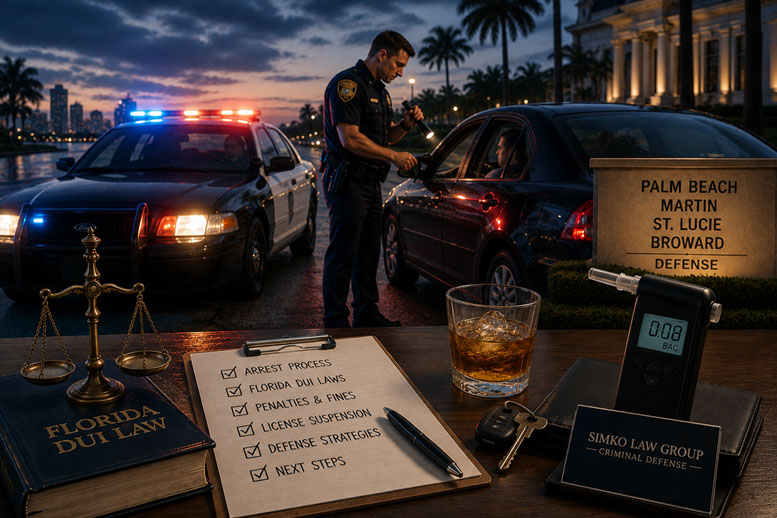
You just got arrested for DUI in Florida, or maybe someone you love did. You probably have just one question at the moment: what happens now? The short answer is that you have more control over this than it feels like, but only if you understand the process completely.
This guide covers everything you need to know about a Florida DUI arrest, including what happens after you’re booked, what Florida DUI laws say about your case, what the penalties look like, and which DUI defense strategies hold up in court.
If you’re searching for a Florida DUI lawyer in West Palm Beach, Palm Beach County, or anywhere else in South Florida, you’re in the right place. Attorney Andrew Simko spent years as a Florida prosecutor before he ever defended someone facing DUI charges.
That means he’s seen these cases built from the state’s side of the table, and now he uses that same insight as a criminal defense attorney working for you, not against you. This is the kind of DUI defense Florida drivers need when this much is on the line.
What Happens After a DUI Arrest in Florida?
A DUI case in Florida moves fast, and many of the most impactful moments happen before you ever set foot in a courtroom.
Let’s say an officer pulls you over, maybe for a traffic violation that has nothing to do with drinking—a broken taillight, a rolling stop, or drifting over the centerline. From there, the officer builds a case by asking questions, watching your eyes and movements, and often requesting field sobriety tests or a breath sample.
If they believe they have probable cause, you’re arrested, taken to a local jail for booking (fingerprints, photo, and personal property logged), and typically, given the chance to post bond so you’re not sitting in custody for the coming days or weeks.
What surprises people the most is the fact that your case splits into two separate cases the moment you’re arrested. First is a criminal court case, and the other is a separate administrative case with the state over your driving privileges.
They each have different requirements and different deadlines you’re responsible for managing. From here, the next steps of a DUI arrest in Palm Beach County specifically depend on local booking procedures and how quickly the State Attorney’s Office reviews your case for filing.
Understanding Florida DUI Laws
Florida’s legal limit is 0.08% blood alcohol content for drivers 21 and older, but the number on a breathalyzer isn’t the only way to get charged.
For example, you don’t have to be driving in order to be charged with DUI. If you’re sitting in the driver’s seat with the keys within reach, even with the engine off, you can still be found in “actual physical control,” which is enough for an officer to arrest you.
A few groups face stricter BAC limits, too:
- Commercial driver’s license holders face a lower 0.04% threshold
- Per Florida law, drivers under 21 face a lower threshold of just 0.02% BAC
- Anyone can still be charged for impairment from prescription medication, not just alcohol
These seemingly minor distinctions run through nearly every part of Florida’s DUI statutes, which is why understanding Florida DUI laws in full can be a major advantage as you and your attorney build a defense strategy.
DUI Penalties in Florida
Florida DUI penalties increase sharply if you’ve had prior convictions or had a high BAC at arrest. Here’s the breakdown:
| Offense | Fines | Jail Exposure | License Revocation |
| First DUI | $500 – $1,000 (up to $2,000 if BAC ≥.15 or a minor was in the car) | Up to 6 months (9 if enhanced) | 180 days – 1 year |
| Second DUI (within 5 years) | $1,000 – $2,000 | Up to 9 months (mandatory minimum 10 days if within 5 years of first DUI) | Minimum 5 years |
| Third DUI (felony if within 10 years) | $2,000 – $5,000 | 30 days – 5 years | Minimum 10 years |
| Fourth DUI | $2,000 – $5,000 | Up to 5 years | Lifetime |
A first DUI conviction alone can mean penalties that follow you for months, if not years, to come. A second DUI conviction within five years of the first carries far harsher penalties— including mandatory jail time.
If your DUI caused death or serious bodily injury to another person, that automatically elevates it to felony DUI, which means you face up to five years in a state prison.
Driver’s License Suspension After a DUI
Your license suspension doesn’t hinge on whether you’re found guilty of DUI. Instead, it happens administratively, often within hours of your arrest, and it’s completely separate from whatever a judge eventually decides.
If you were arrested with a BAC over the legal limit or you refused testing, you have a narrow window (usually 10 days) to request a formal review hearing before that suspension becomes permanent and unappealable.
Within that 10-day window, you’ll be given a DUI administrative hearing date, where your attorney can:
- Challenge whether your arrest itself was lawful
- Challenge whether the officer had probable cause for the stop
- Challenge whether the breath or blood test was properly administered
- Lock in the officer’s testimony under oath, which can be used later at trial if they contradict themselves
Even if you lose that hearing, you’re not necessarily stuck without a car. Most first-time offenders who request a hardship license in Florida within the right window can still drive to work, school, and required medical appointments while the rest of their case plays out.
Missing the 10-day deadline altogether is what limits your options, which is why the work to save your license after a DUI arrest should start the moment you’re released post-arrest.
Breath Tests, Blood Tests & Field Sobriety Tests
Florida relies on three kinds of evidence to build a DUI case, and none of them are 100% airtight, though they might seem that way on TV shows. These are breath tests, blood tests, and field sobriety tests.
First, breathalyzers must be calibrated on a regular schedule under Florida law, and officers must be specifically trained to administer them. If either of those elements isn’t present, your breath test results can be challenged.
Blood tests are more accurate, but come with their own chain-of-custody requirements. If protocol isn’t followed to the letter during hand-off and storage, the results can be challenged.
Field sobriety tests are explicitly subjective and based on the officer’s conclusions. Fatigue, anxiety, uneven pavement, poor lighting, and certain medical conditions can all make a sober person look impaired. Because of this, challenging the accuracy of field sobriety tests is often an effective tactic.
Alcohol typically stays detectable on your breath for several hours after your last drink, with the exact timing shaped by how much you drank, your body weight, and metabolism. which
And while refusing a breath test in Florida is legally an option, it comes with consequences of its own, which we’ll cover in detail further down in this guide.
Common DUI Defense Strategies
“Beating” a DUI rarely comes down to having one silver-bullet argument or courtroom objection. In reality, the key is usually finding which specific weakness applies to your specific arrest, then building the case around it.
The strongest defenses tend to fall into a handful of categories:
- Challenging the traffic stop — Officers need probable cause to pull you over. A stop based on a vague “looked suspicious” call or an uncorroborated tip can get everything gathered afterward excluded.
- Attacking breathalyzer accuracy — These machines require regular calibration and trained operators. We can subpoena maintenance records to check whether either requirement was actually met.
- Challenging field sobriety test administration — Officers must follow specific NHTSA procedures. Deviations, poor lighting, or uneven pavement can all undercut the results.
- Proving no actual physical control — Simply being in the car isn’t enough; where you were seated, whether the keys were accessible, and whether the engine was running all matter.
- Identifying Miranda violations — If you were questioned in custody without being read your rights, those statements may be excluded entirely.
- Raising medical explanations — Conditions like GERD, diabetes, or certain neurological issues can produce signs that look like impairment but aren’t.
- Challenging constitutional violations — Anything from an unlawful search to a mishandled chain of custody on test evidence can open the door to dismissal.
Challenging DUI evidence almost always starts with analyzing the stop itself, since disputing illegal traffic stops can potentially eliminate every bit of evidence that was gathered afterward.
Not every defense applies to every case, though. The DUI defense strategies that work during a checkpoint stop look very different from the ones that work when an officer claims he witnessed erratic driving.
This is exactly why the specific facts of your stop matter more than any general strategy.
Can a DUI Be Dismissed in Florida?
Yes, and it happens more often than most people assume, especially when a defense attorney gets involved early. Getting a DUI case dismissed in Florida usually comes down to one of a few things:
- The evidence was too weak to prove guilt
- A constitutional violation made key evidence inadmissible
- A procedural deadline or requirement was missed by the state
But dismissal is never something that happens automatically. You need a strategic attorney who looks for these errors and weaknesses throughout your case so that they can be leveraged effectively.
Refusing a Breath Test in Florida
Florida operates under “implied consent,” which means that by driving in this state, you’ve already agreed to submit to testing if you’re lawfully arrested for DUI. Refusing has major consequences, and as of October 2025, those consequences have gotten considerably steeper.
A first refusal still carries a one-year administrative license suspension as it previously has, but it’s now also a separate second-degree misdemeanor on its own—meaning you can face criminal penalties for the refusal even if your underlying DUI charge is ultimately dismissed.
A second or later refusal jumps to an 18-month suspension and becomes a first-degree misdemeanor, carrying up to a year in jail.
Lastly, know that first refusal penalties and second refusal consequences are prosecuted as entirely separate crimes, which means even if your DUI charge is dismissed, that won’t automatically clear you of the refusal charge.
Felony DUI Charges
A DUI becomes a felony in Florida under a few specific circumstances:
- It’s your fourth conviction ever
- It’s your third conviction within 10 years
- The DUI caused serious bodily injury or death, also known as DUI manslaughter
Each of these details, if present in your case, will trigger dramatically different stakes.
For example, a felony conviction means losing the right to vote and own a firearm until your sentence is fully served. DUI manslaughter alone can carry up to 15 years in prison and a $10,000 fine.
If you’re facing felony DUI charges in Florida, you should also know that the timeline for building your defense is much shorter than it feels.
You see, state prosecutors take a severe, focused approach to felony-level cases, which means you and your attorney need to review evidence, witness testimony, and even breathalyzer maintenance records as soon as possible.
Palm Beach County DUI Cases
Florida DUI law is governed by the same statutes everywhere in the state, but how your case moves through court depends heavily on where you’re charged.
Palm Beach County has its own DUI court process, its own prosecutorial tendencies, and judges who handle DUI cases differently than their counterparts in neighboring counties, which is exactly why it’s important to find an attorney with local courtroom familiarity and legal knowledge.
Most DUI arrests in Palm Beach County are misdemeanors, which means they’re handled in County Court rather than Circuit Court. But where, exactly, your case lands will depend on which courthouse covers your arrest.
The 15th Judicial Circuit runs DUI arraignments and non-jury proceedings weekly at the South County Courthouse in Delray Beach and the North County Courthouse in Palm Beach Gardens, in addition to the Main Courthouse in downtown West Palm Beach.
If your case heads to a jury trial, though, it gets transferred to the Main Courthouse regardless of where it started.
The county also runs periodic Palm Beach County DUI checkpoints, typically publicized in advance under Florida law, which create their own specific legal questions about reasonable suspicion that don’t apply to a standard traffic stop.
Do You Need a DUI Lawyer?
A conviction can cost you your license, your job, and—depending on your profession—a license to practice it. That alone is reason enough to talk to a lawyer before you say anything else to the police or prosecutors.
The stakes are higher than most people assume going in, too. One Florida county’s 2024 court monitoring report found that 9 out of 10 closed DUI cases ended in a conviction.
That’s why it’s crucial not just to hire an attorney, but to choose one that has the experience and knowledge to craft a strong defense strategy. Here are three questions to ask a DUI lawyer before you hire anyone:
- How many DUI cases like mine have you taken to trial, not just settled with a plea?
- What’s your specific plan for challenging the breath test or field sobriety results in my case?
- What’s the realistic best-case and worst-case outcome, given the facts as you understand them?
You should also be aware that the real difference between a public defender vs. a private DUI lawyer usually isn’t skill, but caseload.
Public defenders in Florida often juggle well over a hundred active cases at once, which limits how many hours go into any single one, while a private DUI attorney Florida clients hire directly can typically commit far more time to investigating your specific arrest.
That extra time is also the key factor which ultimately decides the cost of a DUI lawyer. The hours they spend subpoenaing records, interviewing witnesses, and preparing for a trial all add up over the course of your case.
Common Mistakes People Make After a DUI Arrest
The hours and days right after an arrest are when most people accidentally damage their own case—usually without realizing it until it’s too late to undo. Some of the most common mistakes include:
- Talking too much. Explaining yourself to the police rarely helps and often gets used against you later.
- Missing the DMV hearing deadline. That narrow window to challenge your license suspension closes fast and doesn’t reopen.
- Posting about it. Social media posts, even vague ones, can end up as evidence.
- Waiting to call an attorney. Evidence and witness memory fade with every passing day, which means time is of the essence.
- Assuming a clean record means you’ll be fine. Good people make mistakes, too, but that fact alone doesn’t protect you from the potential consequences.
So, what should you do in the days and hours after a DUI arrest? Say as little as possible beyond identifying yourself, and save your explanation for your attorney, not the officer.
Mark the DMV hearing deadline on your calendar the moment you’re released—even before you’ve hired legal representation—and call a defense attorney right away, since most are reachable 24/7.
Write down what you remember about the stop, the tests, and the arrest while it’s still fresh, even just in your phone’s notes app.
While none of these steps guarantee you won’t be convicted, they do keep your options open instead of closing them before your case has really started.
DUI Defense Florida FAQs
Can a DUI be dismissed in Florida?
Yes, Florida DUI charges can be dismissed when the evidence against you doesn’t hold up. Common grounds include an illegal traffic stop with no probable cause, a breathalyzer or blood test that wasn’t properly calibrated or administered, field sobriety tests conducted outside NHTSA standards, or missing Miranda warnings.
Dismissal isn’t guaranteed, but it’s more common than most people assume, especially when an attorney starts challenging the evidence early in the legal process.
How long does a DUI stay on your record?
A Florida DUI conviction stays on your criminal record permanently. State law doesn’t allow a judge to withhold adjudication for DUI, which is what normally makes a record eligible for sealing later.
Your DUI also stays on your driving record with the Florida Department of Highway Safety and Motor Vehicles for 75 years. The only way to avoid this is to get the charge dismissed, reduced, or win at trial.
Can you refuse a breathalyzer test in Florida?
You can refuse, but Florida’s law changed in 2025. A first refusal still carries a one-year license suspension as it previously did, but it’s now also a separate second-degree misdemeanor.
A second or later refusal carries an 18-month suspension and becomes a first-degree misdemeanor with up to a year in jail. Refusing doesn’t make your case disappear, either, as prosecutors can use the refusal itself as evidence. See Florida Statute § 316.1932 for the full rule.
Will I lose my license after a DUI arrest?
Possibly, but not always immediately. Florida suspends your license administratively the moment you’re arrested with a BAC over the limit or after a test refusal, and this is entirely separate from your criminal case.
You typically have about 10 days to request a formal review hearing and fight that suspension before it takes effect. Many people still qualify for a hardship license for work, school, or medical appointments.
Can tourists get a DUI in Florida?
Yes. Florida’s DUI laws apply to anyone driving in the state, regardless of where their license was issued. An out-of-state or international visitor faces the same criminal penalties as a Florida resident—including fines, possible jail time, and license consequences.
Florida typically reports convictions back to the visitor’s home state or country through licensing compacts, so the consequences can follow them home and into their day-to-day lives.
How much does a DUI cost in Florida?
Court fines alone for a first DUI typically run $500 to $1,000, but that’s just a small piece of the total potential cost.
Add court costs, DUI school, probation fees, years of increased insurance premiums, an ignition interlock device if required, and lost wages from missed work, and a single DUI conviction commonly costs several thousand dollars before legal fees even enter the picture.
Can a DUI be expunged or sealed in Florida?
No, a DUI conviction can never be sealed or expunged, because Florida law doesn’t allow judges to withhold adjudication for DUI the way they can for most other charges. Said another way, once you’ve been convicted, there’s no way to avoid the stigma of having it on your permanent record.
However, if your charge is dismissed, dropped, or you’re acquitted, the arrest record itself may qualify for expungement. If your charge is reduced to reckless driving with a withhold of adjudication, that record may later be eligible for sealing. See Florida Statute § 943.0585 for full eligibility rules.
Can police search my car during a DUI stop?
Not automatically. Officers generally need your consent, a valid warrant, or probable cause (like visible contraband or clear signs of impairment) before searching your vehicle during a DUI stop.
If you didn’t consent and the officer lacked legal grounds but searched your car anyway, anything found may be challenged and potentially excluded from your case under the Fourth Amendment.
Is jail mandatory for a first DUI in Florida?
Not usually. A standard first DUI offense in Florida typically doesn’t carry mandatory jail time, though a judge can sentence up to six months (or up to nine if your BAC was .15 or higher, or a minor was in the car).
Jail becomes far more likely with a high BAC, an accident involving injury, or if this incident isn’t your first arrest, even if it’s your first conviction.
Does a DUI conviction affect my job or professional license in Florida?
It can, depending on your profession. Florida’s licensing boards for real estate agents, nurses, and teachers all require disclosure of a DUI conviction, and each board reviews it independently — even for a first-time misdemeanor. The impact varies by license:
- Real estate agents may face FREC review
- Nurses can face Board of Nursing scrutiny
- Teachers risk certificate review through the Department of Education
If you hold a professional license, it can be wise to loop in licensing counsel alongside your criminal defense attorney.
Facing a DUI in South Florida? Talk to Andrew Simko Today
A DUI arrest doesn’t have to be the end of your story—but how you respond in the days right after it can shape everything that comes next.
Andrew Simko of Simko Law Group spent years as a Florida prosecutor before he ever defended a DUI case, which means he’s seen exactly how the state builds these cases against people just like you. More importantly, that also means he knows exactly how to craft a strategy that fights back against the prosecution and protects your rights.
As a DUI attorney Florida residents throughout West Palm Beach, Palm Beach County, Martin County, and South Florida often turn to, Simko Law Group provides aggressive, straightforward representation, whether you’re facing a first DUI or a felony charge.
You deserve a clear explanation of your options and the steps you can take to protect your freedom, starting today. Call (561) 951-1264 today to schedule your free confidential consultation.